Maintaining the Usage of Applications for Capabilities
Zingoolarity allows you to build intersections between business capabilities, technical applications and products.
This allows you to plot the current architectural picture and incrementally the target architectural picture.
Topics represent parts of our product map (lanes, domains and products / product teams), which take responsibility for the respective applications.
You can switch to the usages associated with a topic by clicking the "Usages” button inside of the topic editor screen.
Initially the screen will be empty and will look something like this:
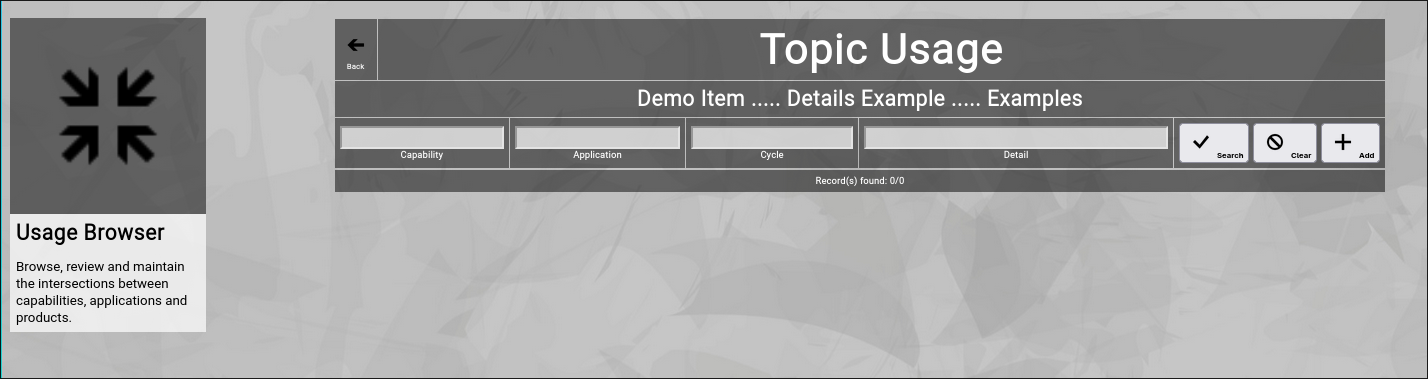
(Zingoolarity topic links screen)
You can now click the "Add” button to add a new usage to the topic.
It will switch to the usage editor screen:
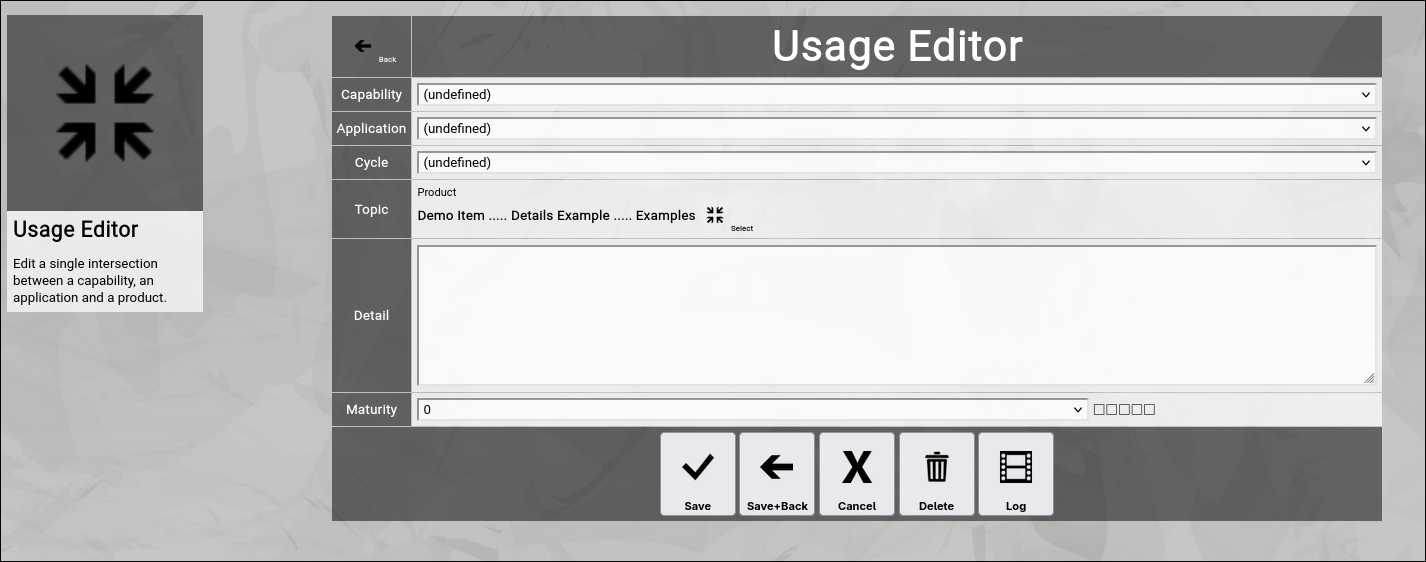
(Zingoolarity usage editor screen)
Let us have a quick look at the available fields:
- Capability
The "Capability" represents the implemented business capability.
It can be selected from a structured list of lane, domain and capability (which represents the official business domain map).
- Application
The "Application" represents the technical building block, which implements the capability.
IT can be selected from an alphabetically sorted list of applications.
- Cycle
The "Cycle" represents the lifecycle state, in which the application implementing the capability currently is.
It ranges from "Target" (target application to be implemented) to "Decommissioned" (no longer used).
- Topic
The "Topic" represents either a lane, domain or (under normal circumstances) a product, which you can select from your product map.
This is implicitly set, as you are in the context of a topic already.
But you can also start the selection process by clicking on the "Select" button.
You will face a breadcrumb, which allows you to navigate topicspace and select the correct item.
- Detail
The "Detail” of a usage optionally further explains what the usage is all about.
Much like the "Detail” of a topic it can manually contain HTML tags (for example a "
” tag to force a line break).
- Maturity
The "Maturity" represents a five star rating, what maturiy level is currently associated with a business capability implemented by an application or what the target maturity level of a to-be-introduced application is expected.
This is helpful for communication purposes about your target architecture landscape.
Much like in the topic editor screen, you have a selection of buttons to complete your input:
- The "Save” button will just save your usage (without leaving the usage editor screen).
- The "Save+Back” button will do the same but return to the previous screen.
- The "Cancel” button will just return to the previous screen (without saving).
- The "Delete” button will request confirmation, will delete the usage and then will return to the previous screen.
- The "Log” button will show a historical transaction log of the current usage (for auditing purposes).
Selecting another Topic of a Usage
Zingoolarity can be configured to show a drop-down box to simply select the topic of a usage "in one go”.
This only makes sense in small Zingoolarity instances, as your topics soon get into the hundreds and thousands, so a simple drop-down box is not practical.
Therefore by default, you have to click on the "Select” button to select a topic.
This will show the following screen:

(Zingoolarity topic selection breadcrumb)
You basically see a breadcrumb to your current topic here.
You can now do multiple things:
- Click the "Cancel” button
This will abort the selection process and return to the previous screen.
- Click on one of the names of the topics above
This will navigate to the selected topic, for example click on "Demo Domain":

(Zingoolarity topic selection breadcrumb with two topics available)
You will now see the topics included in the "Demo Domain” topic.
- Click the "Select” button next to a topic
This will finally select the topic and return to the previous screen.
You can now modify the "Detail” field to your liking and click the "Save+Back” button or simply click the "Cancel” button, if you do not want to add anything in this screen.
The screen will return to the previous screen.
When you return to the previous screen, you will see the usage which you just added in the list of the usages:
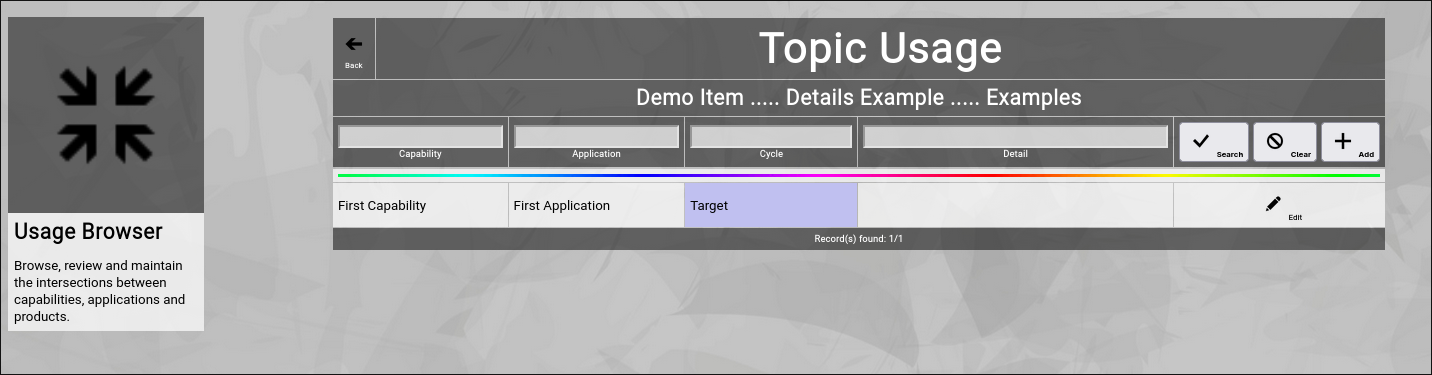
(Zingoolarity topic usage screen with a recently added usage)
And you will also see the "rainbow bar” again, marking the link which you just edited.
This is helpful if there are already many links for the given topic.
The screen will scroll to the last edited link and will highlight it with the "rainbow bar”.
Editing an existing Usage
You will also see the "Edit” button next to each and every usage.
Clicking this button will allow you to switch to the usage editor screen again to make some modifications.
Filtering the Topic Usage
In general, the usages are sorted in alphabetic order of the lane, domain, capability and application.
If you already have many usages added, it might be helpful to additionally filter.
You can enter:
- Part of a "Capability"
to search for the name of a capability.
- Part of an "Application"
to search for the name of an application.
- Part of a "Cycle"
to search for the name of a cycle.
- Part of a "Detail”
to search for a keyword in the details of the usage.
You may click on the "Search” button to perform the filtering or click the "Clear” button to remove a currently active filter again.
Going Back to the Topic
You can click the "Back” button in the upper-left corner to return to the previous screen (in this case, the topic editor screen). |